Author Archives: missphd

DIY Clutch: Tutorial From Knack and Whimsy

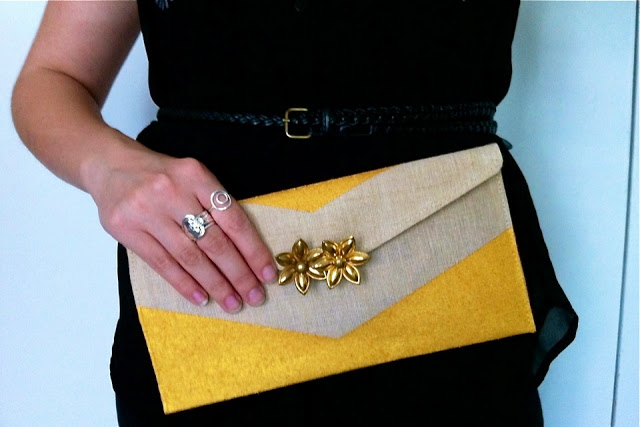
My friend is getting married this weekend and wanted it to give her bridesmaid a cute and stylish gift. She stumbled upon these super chic, adorable and affordable clutches from Knack and Whimsy complete with an easy to follow tutorial!

DIY Painted Purse Tutorial

Photo from Knack and Whimsy – http://www.knackandwhimsy.blogspot.com

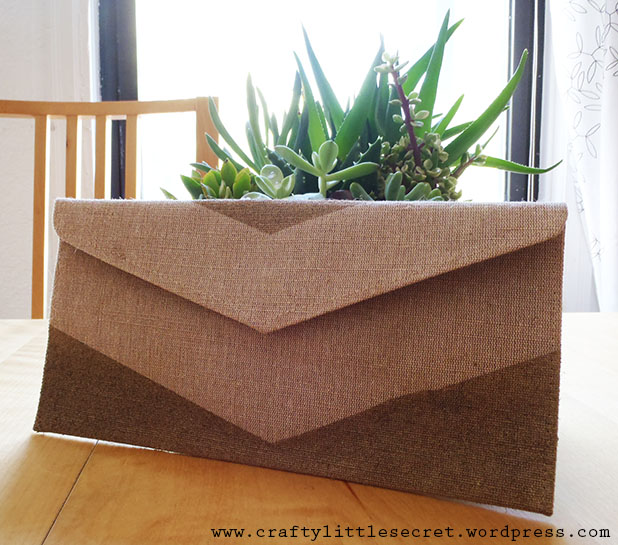
My friend is so busy with her upcoming wedding that I volunteered to help her out a bit and took on painting the clutches. It seriously took me, like, 30 minutes start-to-finish. We even found the exact clutches suggested over at Knack and Whimsy at Hobby Lobby (thanks for the tip!). The only thing we did differently than the Knack and Whimsy tutorial was we used a spray on fabric paint that was not quite as bright as the gold paint in the original post.

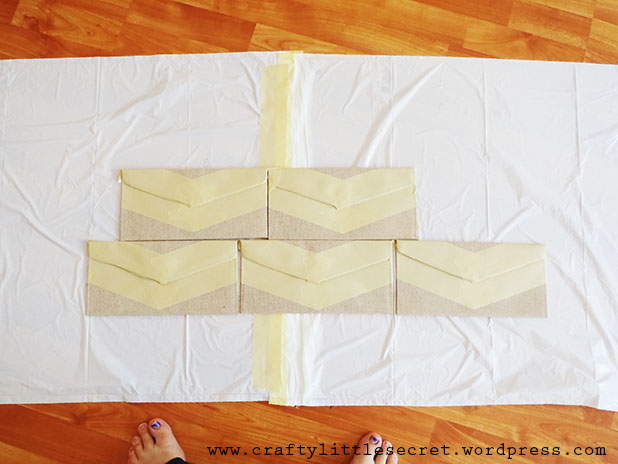
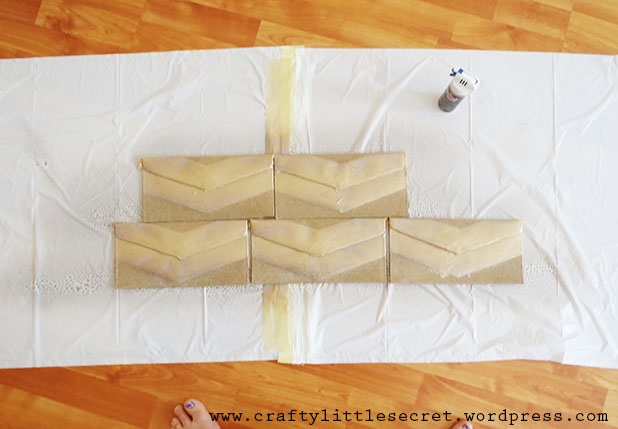
I taped off all the areas I didn’t want painted and laid them out on a garbage bag to keep things neat. When using fabric paint spray, make sure you start and finish the spray off the fabric and to paint with nice even strokes holding the can about 8″ away. The only trouble I encountered was that the paint sputtered on one of the clutches as the can was running out so there’s a spot where the paint is a bit thicker on that one (if you squint you might be able to see the offending blob on the bottom right purse).

DIY PurseDIY Fabric Paint ClutchI waited about an hour for the paint to dry then peeled off the masking tape. They worked great! Thanks so much to Knack and Whimsy for the fantastic tutorial!!!

Hand Painted Purse


Art Under the Microscope

For those of us who do a lot of microscopy at our day jobs, it comes as no surprise that biology can be beautiful. I saw yesterday over at Sew Well that the journal Cell has a feature called “Art Under the Microscope” where fiber artists interpret beautiful cellular images. Go check it out, both the microscope images and the quilts are amazing!

In undergrad I tried to do something similar and would paint microscopy images from my textbooks, with limited success. But then I got to move on to the Big Leagues and got to do a lot of microscopy throughout my PhD and postdoctoral work that really produced some gorgeous images (though not always so scientifically relevant…). Anyhoosidoodle, I thought I’d share some of those images with you here! Three cheers for science!

Art Under the Microscope

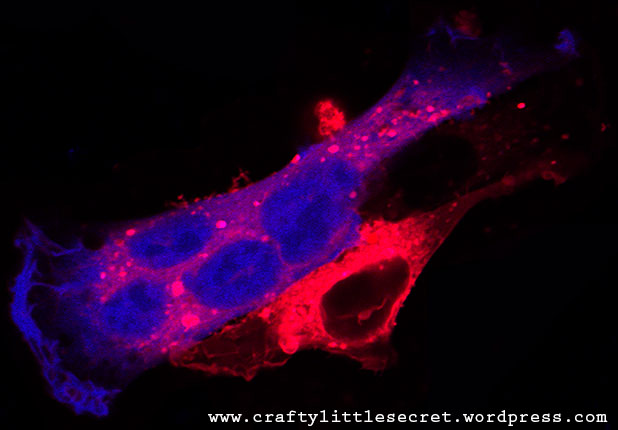
I won a contest with this image during my PhD when it was selected to be the cover art for Grad Student Research Day for the med school.

The image above is showing cellular membrane fusion. You can pick out each cell’s nucleus as the big blue ovals with dark spots in them (or the dark spot in the red cell). Normally, each cell would be self-contained and surrounded by it’s own membrane like a sack (think: fried egg). In the blue cell though, you can see that all these cells share the same membrane/”sack”. Their membranes have fused together making one giant cell with multiple nuclei! Some viruses use this “membrane fusion” phenomenon to infect cells and spread throughout the body and that, in a nutshell, is what I’ve spent a lot of my career so far studying.

Art Under the Microscope

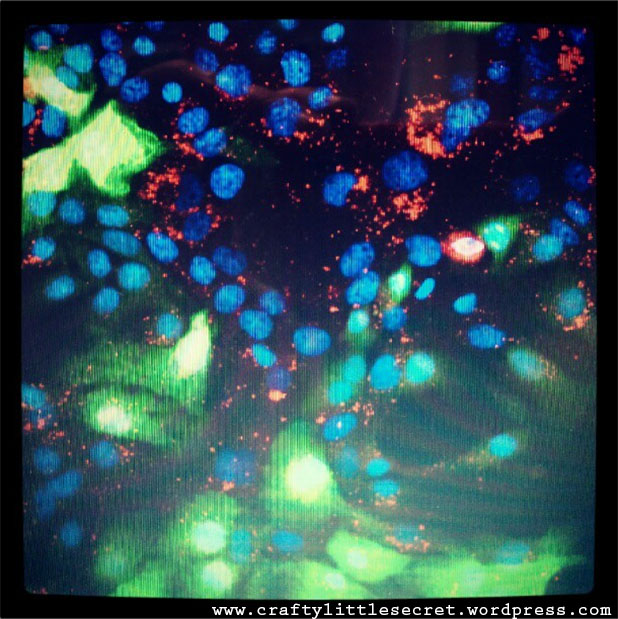
Sorry for the poor quality, this is an instagrammed picture of a computer screen, LOL!

I got teased a little for instagramming my science but I just thought it was so pretty I couldn’t help myself! The big blue ovals in this picture are individual nuclei and all the little red dots are viruses!!! The green is something called “green fluorescent protein”, or GFP. It was first discovered as the cause of bioluminescence in certain species of jellyfish but has since become one of the most powerful tools in molecular biology!! (I love that story because it’s a great example of why basic science should be funded – you never know what you’ll discover or how it will be used in the future!)

Ok, that’s enough geeking out for one Saturday afternoon!

Scoop Top: Pattern From Skirt As Top

Skirt As Top Scoop Top Free PatternOh, hello there! Don’t mind me, I was just enjoying the start of summer in San Francisco (in September) on a lovely fog-free evening in my new me-made t-shirt!!

I used to think that sewing was just for special occasions, but I’ve seen so many inspiring sewists (like those that participated in Me Made May) on various blogs around the interwebs who make nearly all their clothes! I love the idea that one day I could have a wardrobe that was almost entirely made by me! And with that thought in mind I endeavored to do something I hadn’t tried before – make myself a basic t-shirt.

I found a free pattern for a Scoop Top online at Skirt As Top  and thought it looked like a super cute and easy little shirt. The extra nice thing about this pattern was that the sleeves and body were cut as one piece, completely enabling me with my sleeve attachment phobia. The pattern is only currently offered as size S/M so I had to make some alterations to increase it to an XL (stay tuned for a tutorial for how to re-size a simple pattern), but other than that I did something crazy for me……I actually followed the online instructions! Whaaaa?!?!!

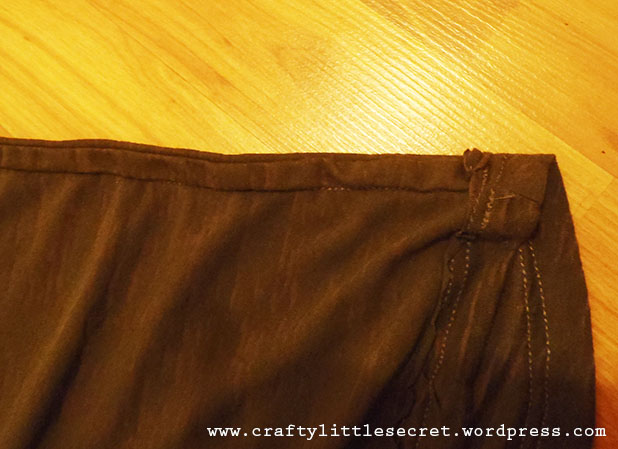
I had a brown burnout lightweight jersey that I’d bought from the odds and ends bin at the fabric store for about $1.99/yard that I thought would be perfect for this project. Just for shits n’ giggles, when constructing this top I decided to try out French seaming on the side seams and it worked out pretty well.

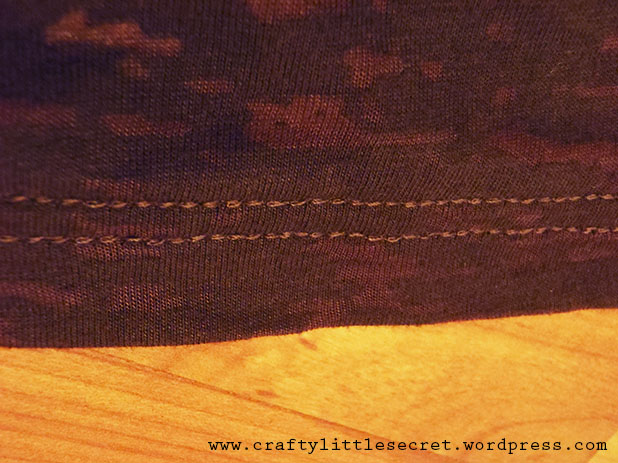
OLYMPUS DIGITAL CAMERAI decided to do a double seam at the hem to make it look a little more finished and to also add a little extra durability. I also sewed the entire top using the stretch settings on my sewing machine which made things go more slowly but was definitely a good move with this stretch knit.

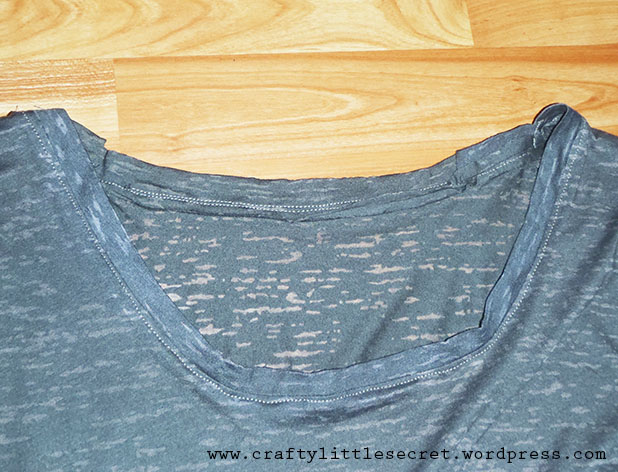
OLYMPUS DIGITAL CAMERAThe only wee problem I had with this shirt was with the neckline. I found that even with ironing it kinda gapes open a bit. I even tacked it down a bit at the shoulders, which helped the funny sticky-uppy thing it was doing there, but didn’t help the gaping. I was wondering if maybe the fabric stretched too much when I was ironing it before sewing??? I dunno, but I made the best of it and added a top stitch to finish it.

OLYMPUS DIGITAL CAMERALook at me!!! In my first me-made t-shirt! Who knows, maybe next year I’ll have enough hand sewn items in my wardrobe to participate in Me Made May!!!! Dare I dream????

OLYMPUS DIGITAL CAMERAA special thanks to my guest photographer, Alxious. She’s a funny kid who makes me laugh but doesn’t tell me when I have hair in my eyes!! Get me Hair and Makeup, heads are gonna roll for this one!!!….

OLYMPUS DIGITAL CAMERA

Wedding Dress DIY: Custom Touches to Ready-to-Wear

My husband and I left ourselves just five weeks to plan our beautiful San Juan Island family-only wedding this summer! Five weeks! It came together so perfectly though, that I now truly believe wedding planning takes as long as you have to plan the wedding, be it five weeks or five months.

The one thing I was really worried about was my wedding dress. Having recently done some support shopping with a friend who’s getting married at the end of this month, I knew that most stores need at least 3 or 4 months to order a dress as well as time for alterations. That left just off-the-rack options. Unfortunately, the vast majority of stores carry size 6-10 for their samples with very little selection in the plus sizes, so I didn’t even try wedding boutique sample sales. Instead, I opted for what seemed like the only option: online ready-to-wear.

I found a beautiful wedding dress that perfectly fit what I had imagined (for under $200!!) from the unfortunately named Trashy Diva (also occasionally available from ModCloth). The Honey Dress was the right length for me, a gorgeous peach-hued ivory color and was retro inspired without leaving me feeling like I was in a costume. There were just a couple details I wasn’t happy with. Fortunately, as you’ll see, it’s easy to add very small and easy DIY touches to really add some custom features and unique details to your ready-to-wear wedding dress!

Wedding Dress DIY Before 2The first issue was that this dress showed just a teensy bit more cleavage than I wanted to show on my wedding day! The second issue was that I thought this dress was just begging for some sort of belt to visually separate the bodice from the skirt. The cleavage issue was solved with a quick hand-sewing project and the belt issue had an easy no-sew solution!

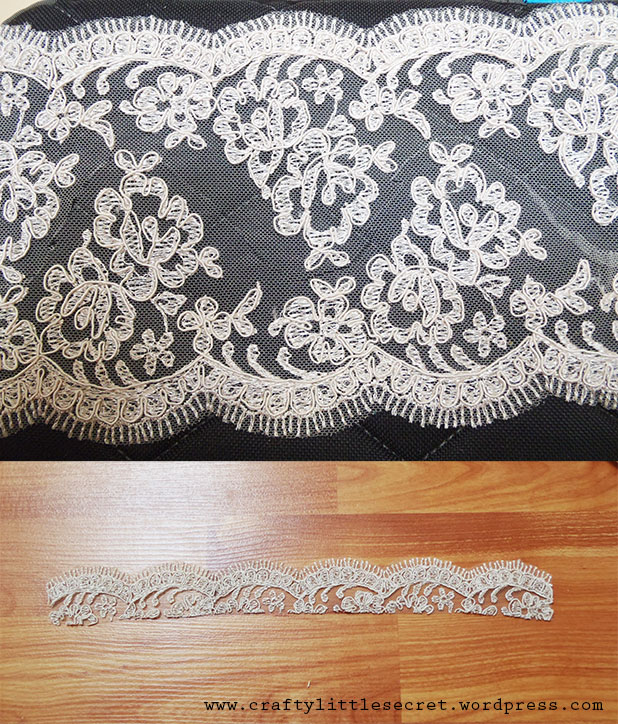
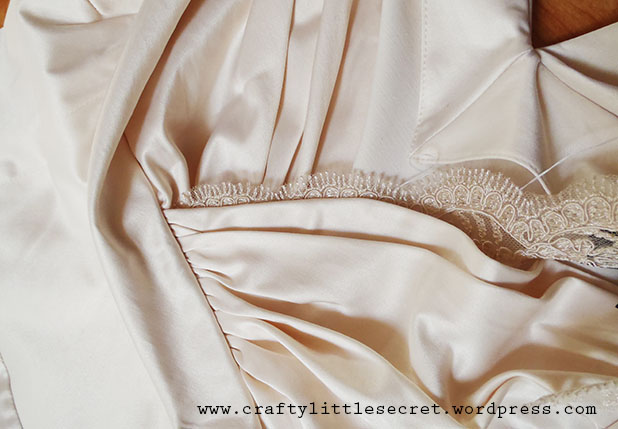
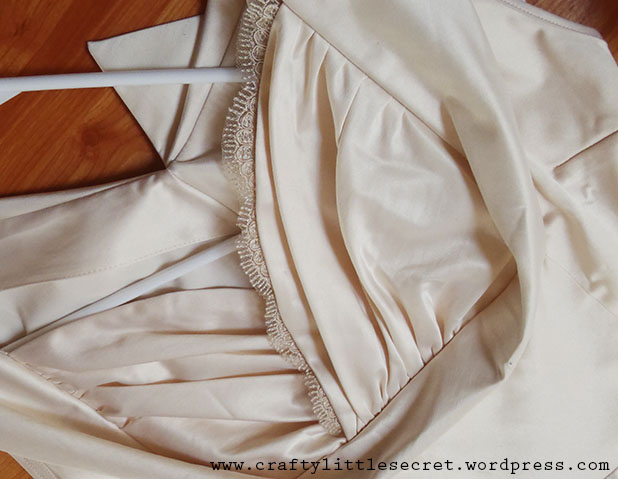
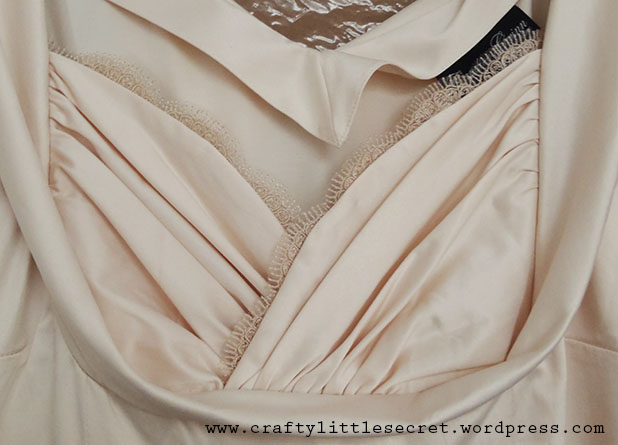
To reduce the amount of cleavage I was showing but leave the open, sexy and classic feel of the neckline, I decided to edge the neckline with some beautiful lace that I found at Britex Fabrics in San Francisco. I made sure to bring the dress with me so I could perfectly match the lace to the dress in both color and style.

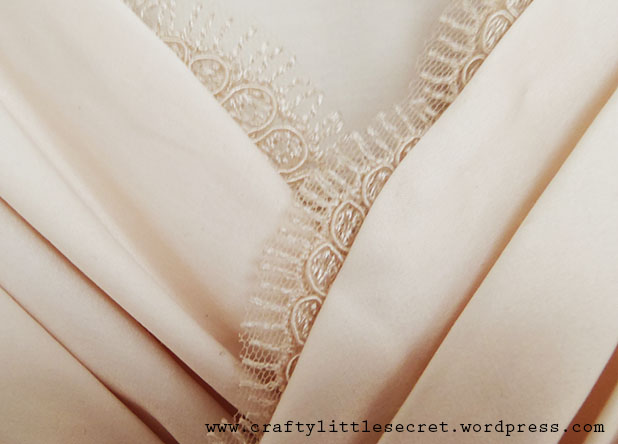
Wedding Dress DIY LaceThese beautiful laces can cost a pretty penny so the smart woman who helped me at Britex pointed out that since the lace I chose was double sided, I only needed to buy half the required length! I cut the lace in half to have enough to cover both sides of the bust.

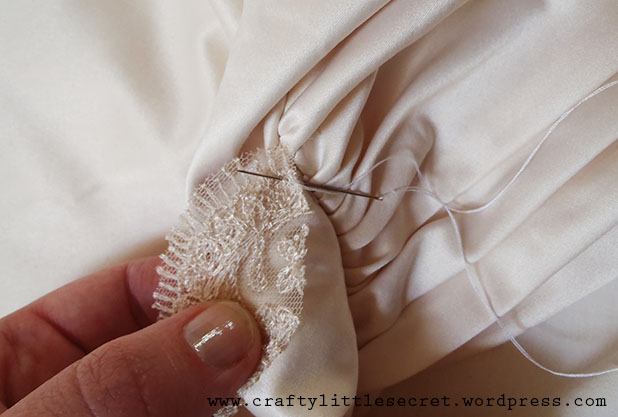
I hand stitched the lace to the inside lining of my dress using whip stitch and being very careful to not put my stitches through the front side of my dress.

Wedding Dress DIY 2

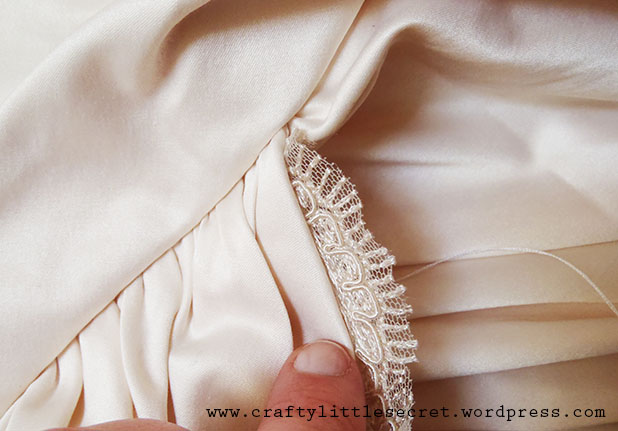
Wedding Dress DIY 3I slowly worked my way along the lace making sure that I took a step back here and there to check that the lace was perfectly lined up (I didn’t pin it because I didn’t want to have any visible pinholes).

Wedding Dress DIY 4To be honest, I was a little nervous about sewing the lace to the dress. I just never pictured myself as a “lace” girl, and was afraid I’d wind up just wrecking the dress. But once I finished one side of the neckline and could see the side-by-side comparison, I loved the alteration!

Wedding Dress DIY 5I was really happy with the finished product with just a hint of the lace peaking over the edge of the dress. It didn’t add much fabric but that half inch or so of lace went a long way in covering up my cleavage and making me feel more comfortable and classy in my dress. It also gave my dress a custom detail and made me feel that much more special on my wedding day!

Wedding Dress DIY After

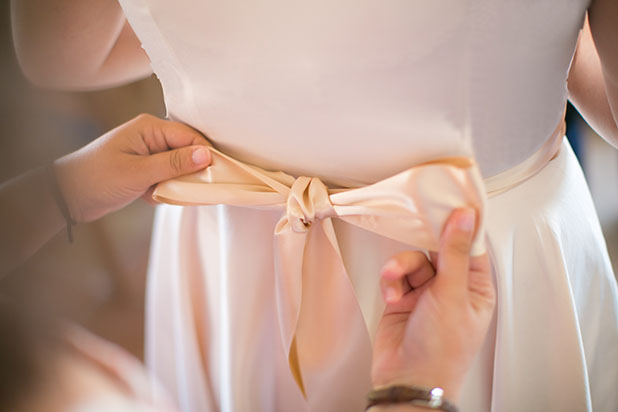
Wedding Dress DIY After DetailTo solve the second problem of a belt for the dress, I once again turned to the Britex notions section. I purchased a nice long length of a ribbon that matched the ivory of my dress but was just a few shades darker. I had originally wanted a thinner ribbon, but I’m so glad I listened to the Britex sales clerk. She was pretty adamant that I need a ribbon that was closer to 3″ wide and in the end I really think that she was right!

Wedding Dress DIY Bow

Photo adapted from one taken by our fanastic photographer, Matt Land – matthewland.com

On my wedding day I had my maid-of-honor tie a nice big bow in the back of my dress and we snipped the ends of the ribbon with an angled cut for a nice finished look.

All in all, I really think these two little DIY touches added so much to the look of my wedding dress! Not only did they make me feel special and unique, most importantly they helped solve some simple fixes to make me feel comfortable on my wedding day!

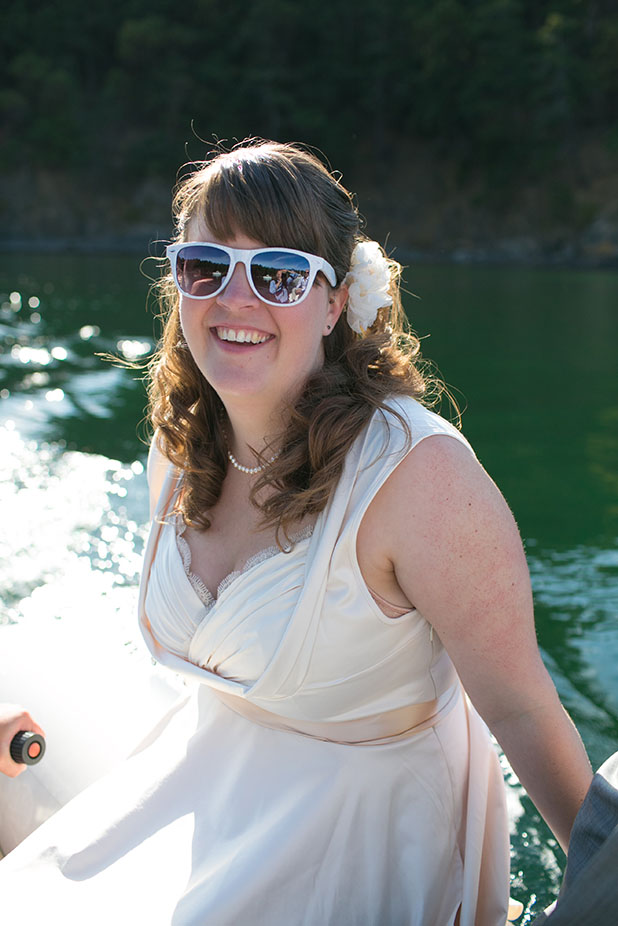
Wedding Dress DIY Wedding Day

Photo taken by our amazing Seattle area photographer Matt Land – matthewland.com


Tutorial: Mending A Torn Dress Shirt

OLYMPUS DIGITAL CAMERAI’m not sure why exactly, but my husband has gone on an elbow-tearing bender with his work shirts. Right in front of my eyes he tore the elbows out of two shirts while putting them on yesterday morning! We’re trying to keep to a budget these days (and try to live frugally and consciously in general) so I decided to try to mend the shirts to avoid buying new ones (four in total!!!). I’ve written up a little tutorial here that I hope is easy to follow!

Materials:
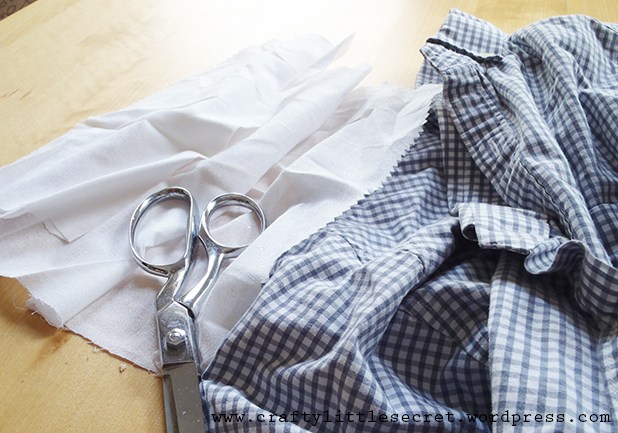
OLYMPUS DIGITAL CAMERA scissors
– iron
– thread in the color of the shirt
– fusible interfacing

Step 1: Interfacing.
To add some stability to the torn area, I first started by fusing a small patch of interfacing to the shirt. Fusible interfacing is two-sided; fabric on one and little bumps of glue on the other. You can see in the picture below the smooth side of the interfacing is in the foreground and the fusible side in the back.

OLYMPUS DIGITAL CAMERAI cut a patch of interfacing about at least a half inch larger than the tear in each dimension. I’ve also found with past experience that round edges are less likely to peel up than sharp corners, so cut out a oval rather than a rectangle.

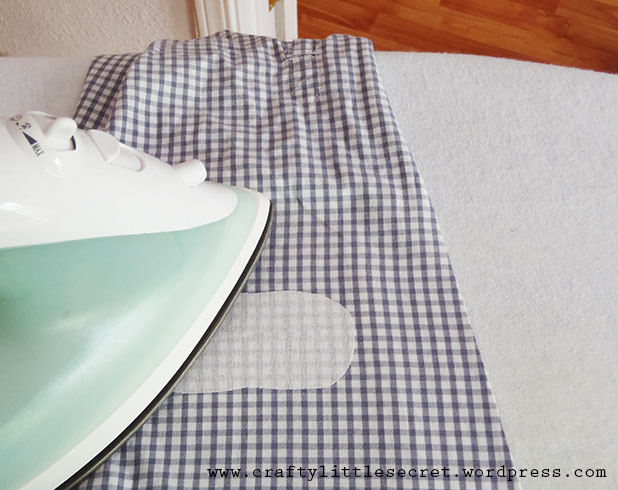
OLYMPUS DIGITAL CAMERALay the shirt on the ironing board then lay the interfacing patch on top of the tear, glue bump-side down (contacting the shirt). Try to pull the tear together as much as possible so that the two torn sides of fabric are in contact. This will make your mending job easier and less noticeable. Set your iron to as high a heat as your fabric will allow and iron with even, firm pressure for about 15 seconds then allow to cool.

OLYMPUS DIGITAL CAMERA

Step 2: Sewing the Tear
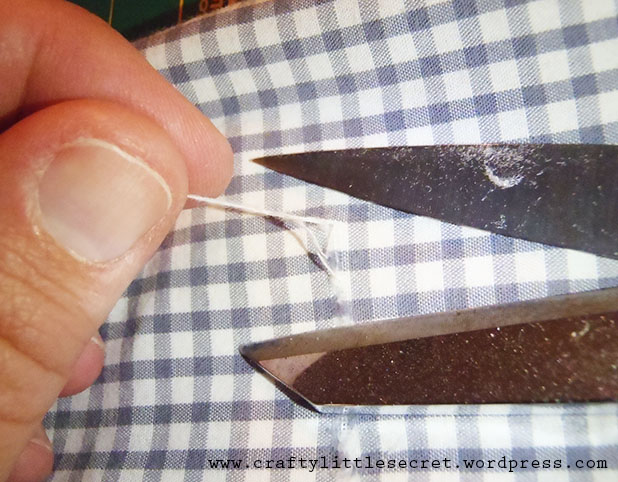
First neaten up the tear by trimming any loose threads that are hanging off the shirt.

OLYMPUS DIGITAL CAMERANext, you need to sew the tear itself closed. You’ve got two options for this depending on how noticeable you want the final tear to be. Option 1 is waaaaaaaaaaaaaay faster, but definitely a more noticeable mend and may work better on non-patterned shirts.

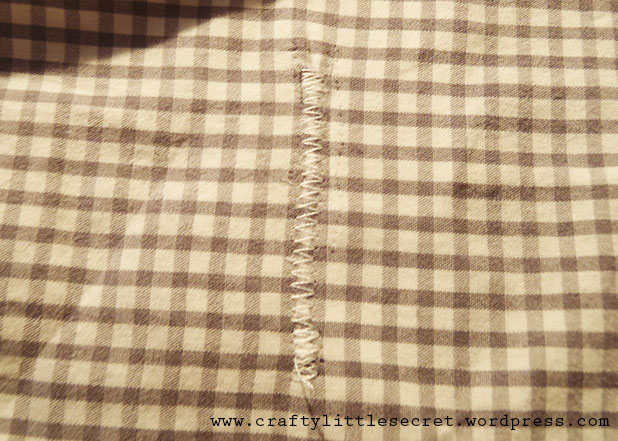
Option 1: Set your sewing machine to a wide zigzag stitch and top stitch over the tear, making sure to backstitch at the beginning and end of the sew and to catch both sides of the tear while sewing. You’re left with a neat mend, but one that can definitely be noticed.

OLYMPUS DIGITAL CAMERAI tried Option 1 first, but since my husband was going to be wearing these shirts to work and potentially meeting clients, I decided to take the time to do Option 2, an (almost) invisible repair.

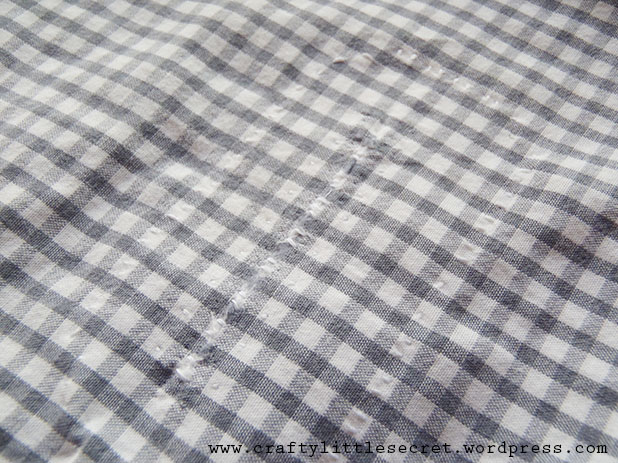
Option 2: This option is much more tedious than the first because it requires hand-stitching. Using the smallest stitches possible, I sewed over the tear making sure to catch both sides of it. Since this was a patterned shirt, as I sewed I tried to keep my stitches with the white thread to the white parts of the check pattern. I then sewed in a similar fashion about 2 mm around the tear for extra stability.

OLYMPUS DIGITAL CAMERATear??? What tear?? Ok, it’s not quite invisible and you’ll never have a perfect mend but this is pretty darn close!!! Keep in mind this image is zoomed in on the tear and when he’s wearing it, you’re really hard pressed to find it!

Step 3: Secure the Interfacing
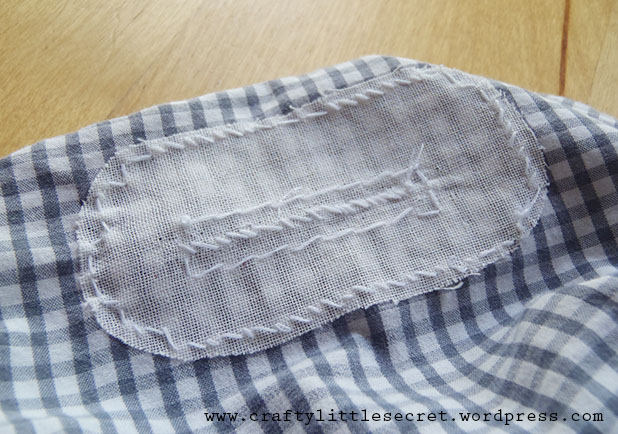
I find that over successive washes, fusible interfacing often starts to peel up off the fabric it was attached to. To try to keep this from happening, I also used tiny stitches around the perimeter of the patch, keeping to the white parts of the pattern to secure the edges of the interfacing and add extra stability (You can just make this out in the picture above).

Here’s how the wrong side of the repair looks:

OLYMPUS DIGITAL CAMERAI’m hoping these repairs, hold up in the wash and I don’t find myself repeating this process too often! Fingers crossed!

Bike Storage Corner

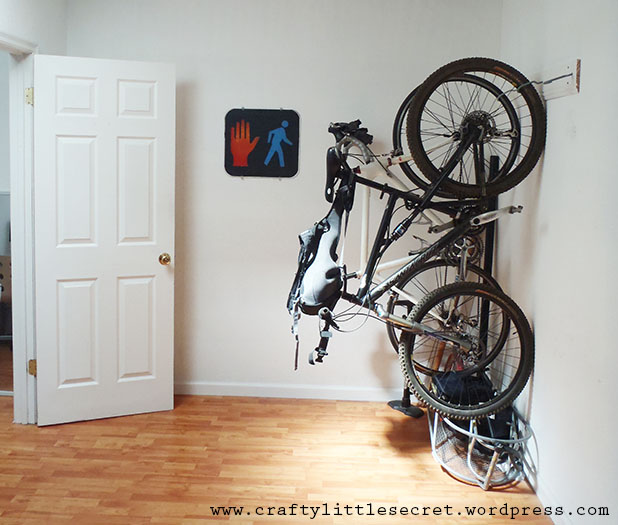
Bicycles are one of those things that are always tricky to store. They’re weirdly shaped and bulky, but need to be stored somewhere that they can be accessed easily. My husband came up with a nice solution for his bikes by creating a rack that puts them on display.

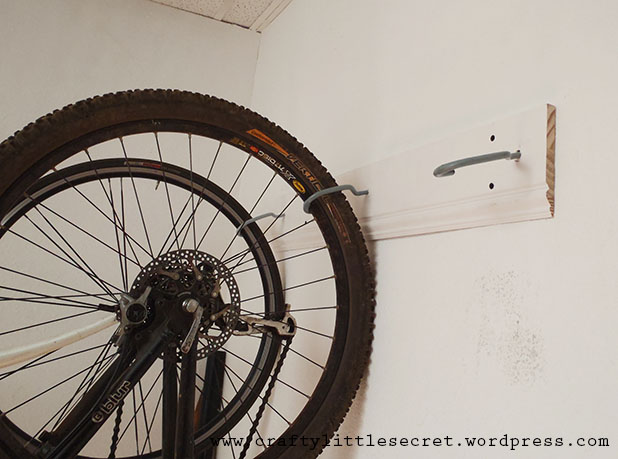
OLYMPUS DIGITAL CAMERAHe cut a piece of wood trim to about 3 feet in length and secured it to the wall, making sure to hit studs with the screws. He then screwed in 3 large hooks from the hardware store that the bike wheels hook into.

OLYMPUS DIGITAL CAMERAAs you can see from the picture, the wheels leave dirt smudges on the wall where they hit, but just adding two more strips of board (one at the front and one at the back wheels) would save the walls.

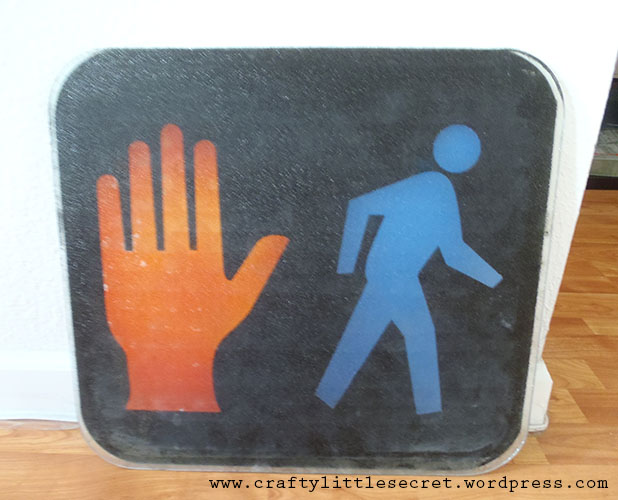
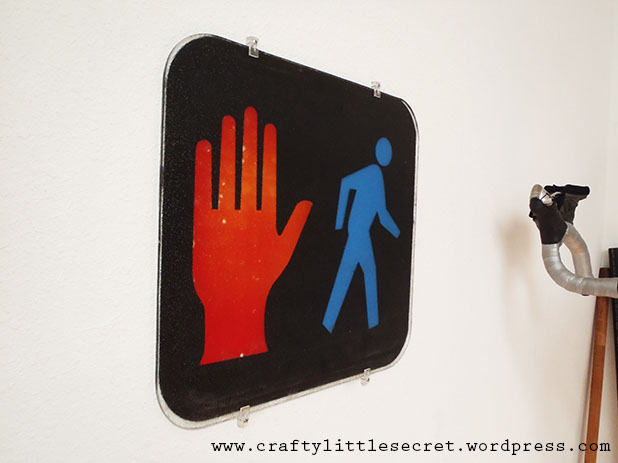
To help add a little more interest to the corner and continue the transit theme, I added an old glass street sign we picked up at our local rebuild center, Building REsources in San Francisco (more about the center and our other find next week).

OLYMPUS DIGITAL CAMERAI just cleaned up the front and back with glass cleaner to brighten it up a little. I attached it to the wall with a mirror holder kit  that uses little plastic clamps to hold the glass artwork to the wall. Since I didn’t encounter any studs where I wanted to hang the sign I made sure to use drywall plugs that came with the kit for extra security. And voila!

OLYMPUS DIGITAL CAMERA


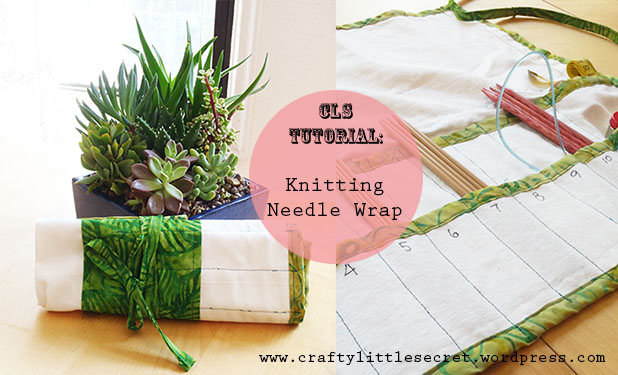
Tutorial: Knitting Needle Wrap


OLYMPUS DIGITAL CAMERA
After wrestling with a messy bag of loose yarn, needles and other knitting bits, I finally decided that it was time to make a proper wrap to keep my knitting needles organized. It’s a simple project that takes just a couple hours from start to finish (or less with a few shortcuts!).

Materials:
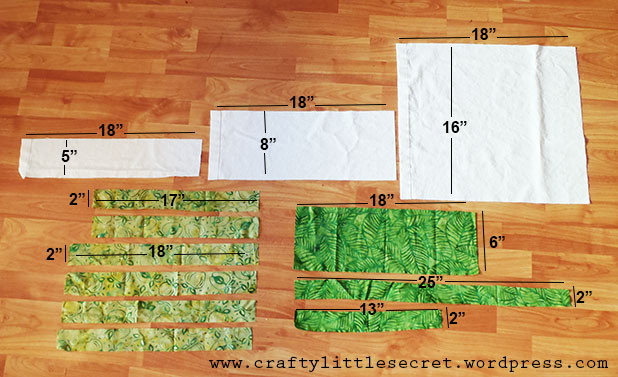
– Three pieces of your main fabric** cut into the following sizes;
– 18″ x 5″
– 18″ x 8 ”
– 18″ x 16″
– Three 2″ wide strips of edging fabric (or bias tape) cut to 18″ lengths
– Two 2″ wide strips of edging fabric (or bias tape) cut to 17″ lengths
– 2″ x 25″ piece of tie fabric (or ribbon)
– 2″ x 13″ piece of tie fabric (or ribbon)
(Optional: 18″ x 6″ piece of decorative fabric)
– thread
– scissors

**To make your life easier and your project neater, try to choose a fabric without obvious right and wrong sides. A heavy cotton will hold up well. I used the leftover scraps from some curtain panels.
OLYMPUS DIGITAL CAMERA

Step 1: Preparing your edging
This step is essentially creating your own bias tape, so it can be a real time saver to just use bias tape for this step instead of contrasting fabric as I have here. To create your edging you’re going to want to make sure your iron is heated  up!

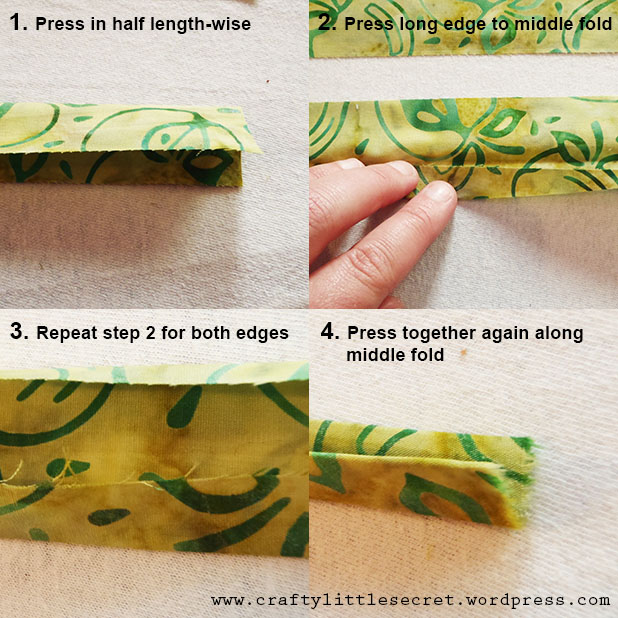
First, press each strip of fabric in half length-wise, creating a center crease (wrong sides together). Open up the folded fabric, then bring each long edge to the center crease and press again. You should now have a long strip of fabric about 1″ wide with two long edges folded to meet in the middle. Finally, recreate that strong center crease by folding the fabric in half length-wise again, hiding the fabric edges on the inside.

Press the fabric for the ties (skip this if you’re using ribbon for the ties instead) in the same manner.
OLYMPUS DIGITAL CAMERA

While you’re at it, with wrong sides together, go ahead and iron a half inch seam allowance along the long edge of your contrasting fabric for the decorative strip around the outside of the wrap.

Step 2: Sew decorative strip
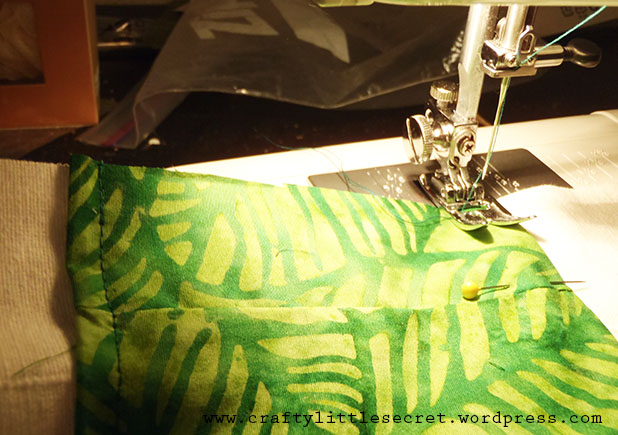
Take the 18″ x 6″ contrasting fabric you just pressed and top-stitch it to what will be the outside of your wrap on the largest piece of main fabric. Placement doesn’t need to be precise but the top of the strip should be around the middle of the main fabric.
OLYMPUS DIGITAL CAMERA

Something to take into consideration if you’re using contrasting fabrics is that the stitching will be visible from the other side. So if you care about that (which I don’t on a project like this) you may want to match your needle thread to the decorative panel and your bobbin thread to your main fabric.

Step 3: Sew edging/bias tape to top edges
Using 3 of the 4 pieces of 18″ long edging, pin one piece of edging to each piece of main fabric along the 18″ side. You’ll want to insert the piece of main fabric into the edging fold so each side of the main fabric has decorative edging on it.
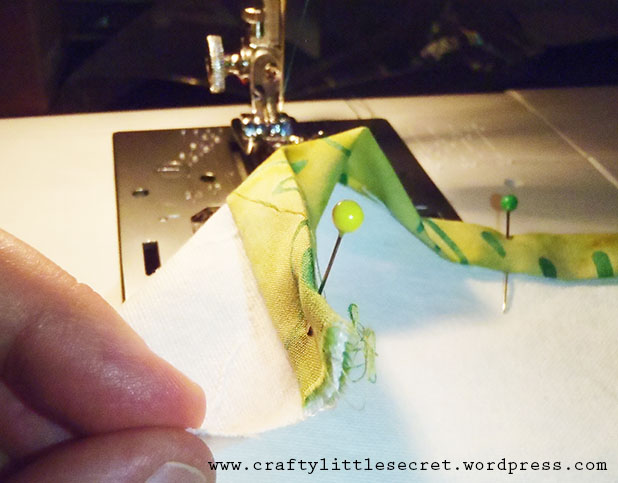
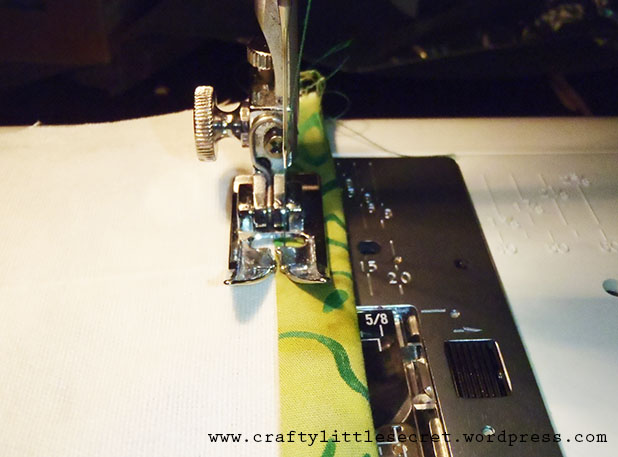
OLYMPUS DIGITAL CAMERANow carefully sew along the edging as close to the open side as possible. Remember that these stitches are meant to catch both sides of the edging fabric, so check periodically to ensure you are doing so.
OLYMPUS DIGITAL CAMERAYou should now have three pieces of your main fabric, each with a strip of edging sewn to one of the long edges.

Step 4: Sew the bottom edge
Line up your three pieces of main fabric along their bare bottom 18″ edge and baste all three together. This basting step makes it way easier to sew the edging on. Now sew your final piece of 18″ length edging around this bottom edge. This stack will be a little thicker than the first edges so make sure your catching both sides of the edging/bias tape when you sew.
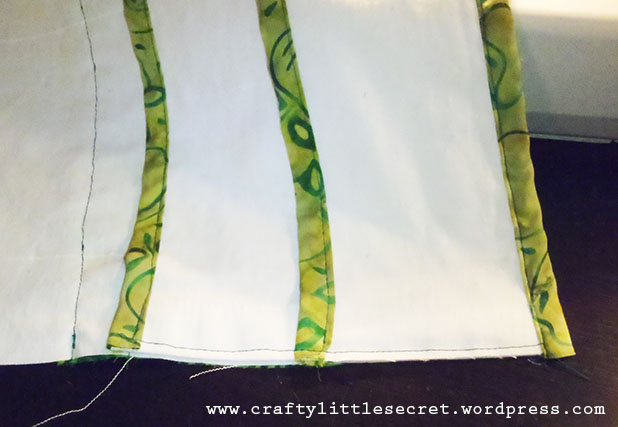
OLYMPUS DIGITAL CAMERA

(Notice on this picture the stripe of green stitches – this is showing through from the decorative strip on the outside of the wrap and can be avoided as I described above).

Step 5: Sew the sides
Next, baste the overlapping sides of the fabric as you did along the bottom edge (this is visible in the picture above), then cover these with the 17″ long edging strips. The sides of the main panels are 16″ long so you should have about an inch of overhang with the edging. Center the edging so you’ve got a half inch of overhang on either end, then fold under and pin before sewing.
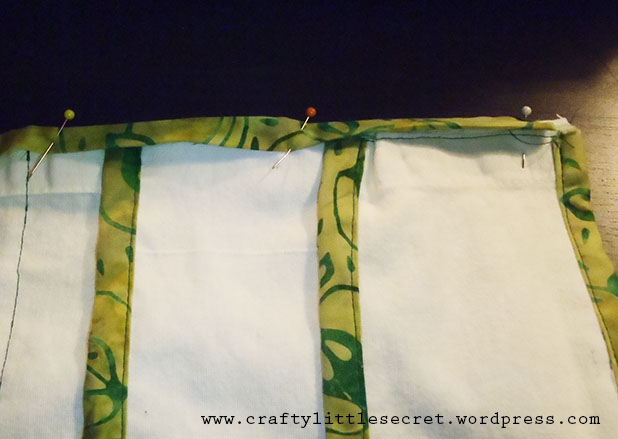
OLYMPUS DIGITAL CAMERA

Step 6: Sewing the ties.
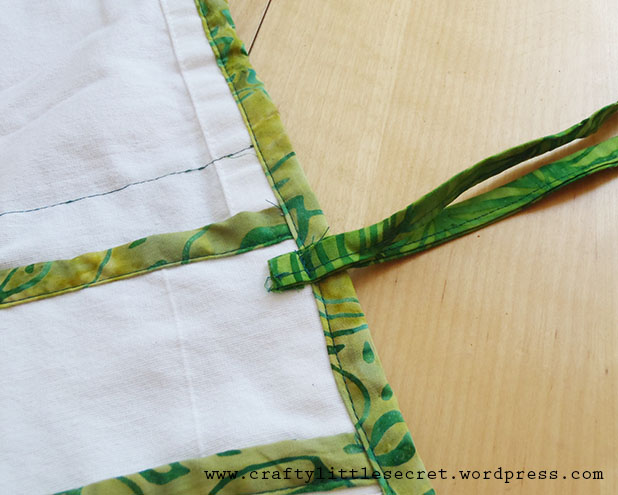
This is another easy shortcut for this pattern. Instead of making your own ties, you can simply buy lengths of coordinating ribbon. If you’re making your own ties you should have them pressed as you did for the edging. Top-stitch the ties as close as possible to the open edge.
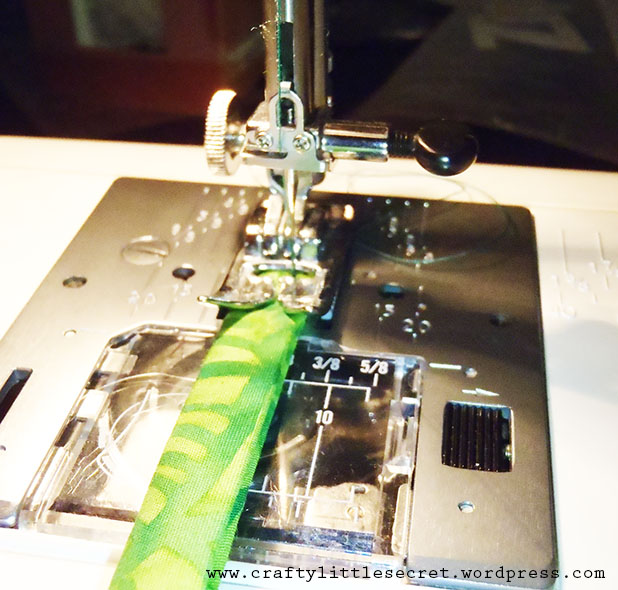
OLYMPUS DIGITAL CAMERAOnce you’re ties are made you can sew them the right side of your wrap on the inside. Try to line them up with the center of the outside decorative strip.
OLYMPUS DIGITAL CAMERA

Step 7: Pockets
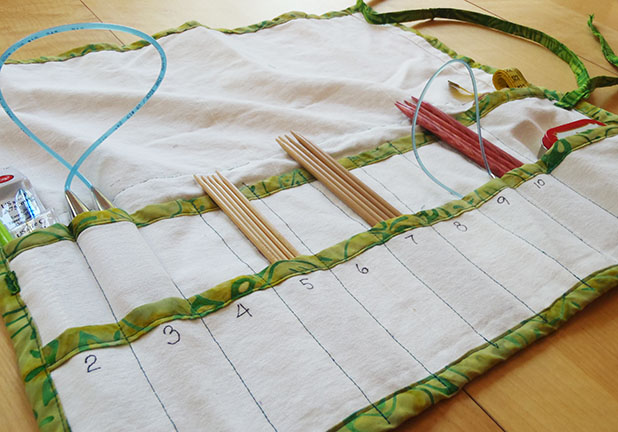
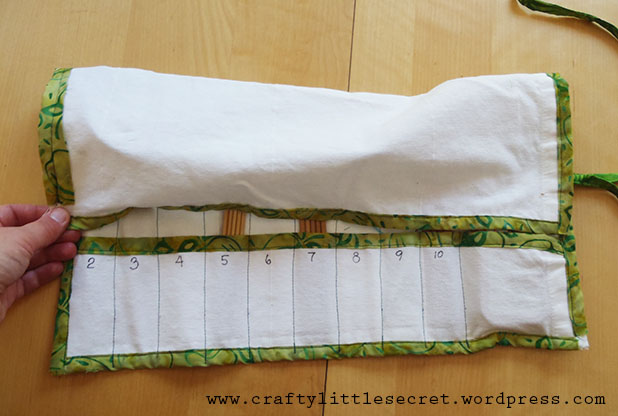
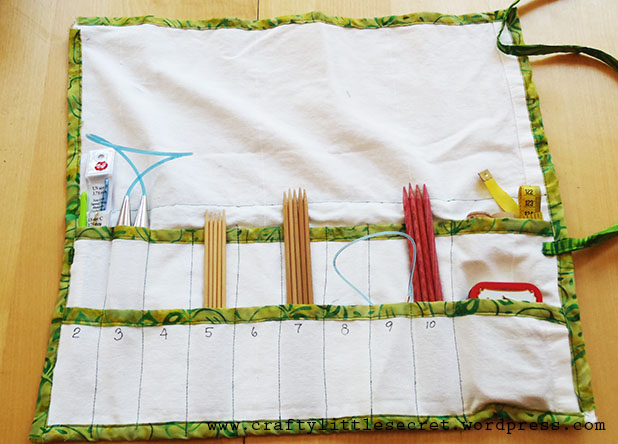
The final step is just to sew some pockets to hold your needles and notions. Top-stitch straight lines from the bottom edge of the wrap to the top of the second pocket (8″ height). I sewed one of these lines every 2 inches because I rarely use really chunky needles. My size US19 needles barely fit in a 2″ pocket, so if you have a lot of chunky needles you may want to consider different spacing. I also left a larger pocket on one side to hold odd shaped bits and pieces.
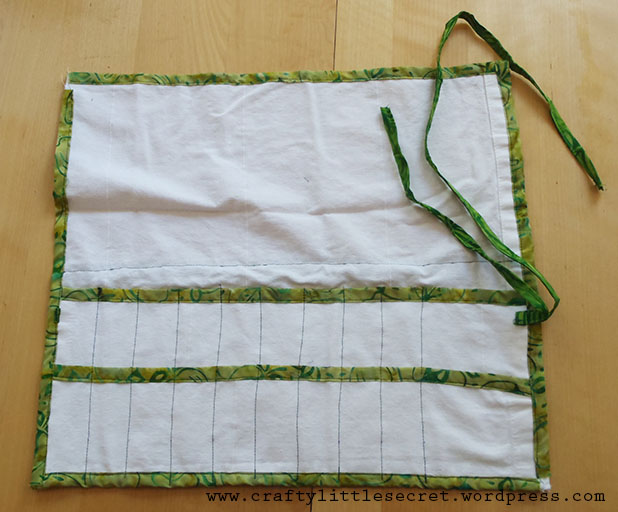
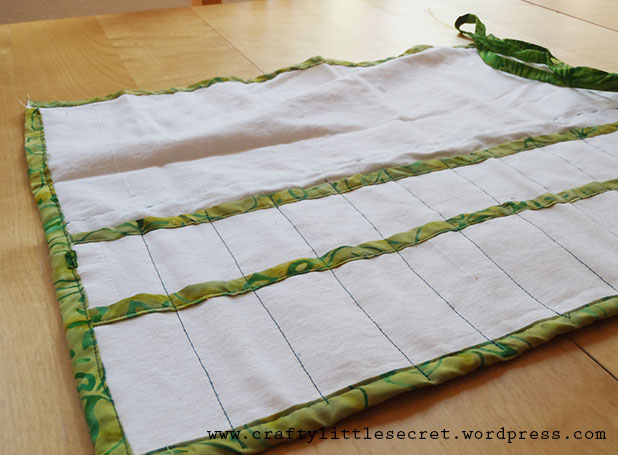
OLYMPUS DIGITAL CAMERAOLYMPUS DIGITAL CAMERAAnd that’s it! You’re done! Go ahead and fill your new knitting needle wrap! As you can see in the pictures below, I also chose to label some of the pocket with needle sizes I commonly use, but keep in mind that this prevents reorganization of the roll in the future.

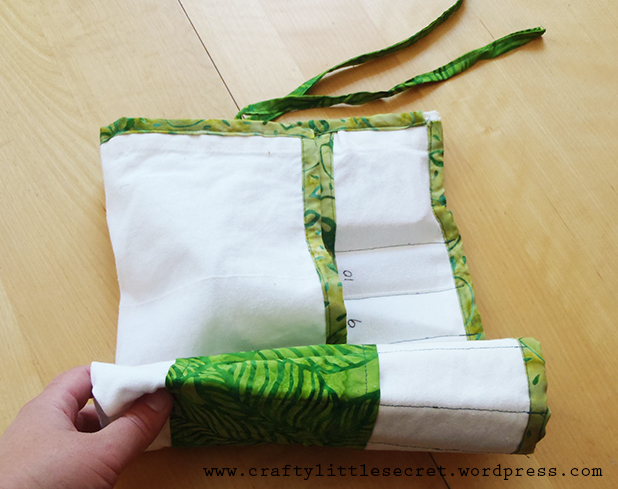
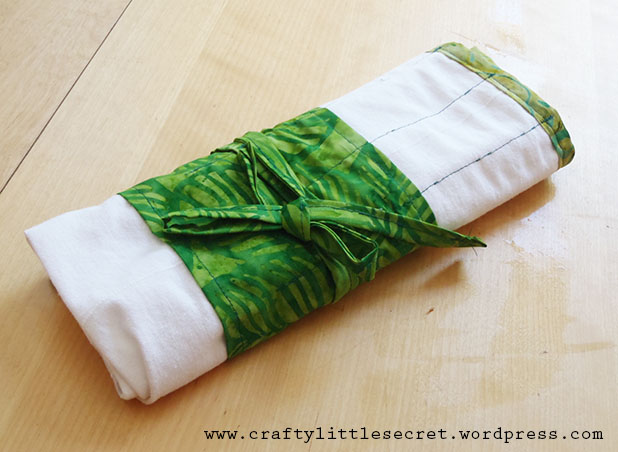
Stuff, fold, roll, and wrap! And away you go with your very own handmade knitting needle wrap!

OLYMPUS DIGITAL CAMERAOLYMPUS DIGITAL CAMERAOLYMPUS DIGITAL CAMERAOLYMPUS DIGITAL CAMERA

OLYMPUS DIGITAL CAMERA

Around the House Tip: Freezing Portions

I often have recipes that call for just a small portion of a can of tomato paste or a jar of broth, and end up with the majority of the container leftover. Usually I freeze the leftovers because I just don’t use them quickly enough, but then the next time you need a small amount of the broth you have to thaw a big jar of it to get the bit you want. Annoying!

Solution: freeze in small portions!

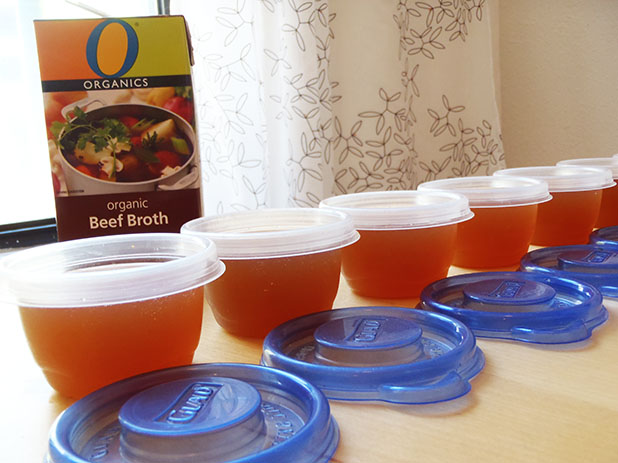
Once I’ve taken the broth I need for the recipe I’m making, I pour the rest out into half cup measures for freezing. The little Glad brand cups are exactly a half cup and are great for this function!

OLYMPUS DIGITAL CAMERAOLYMPUS DIGITAL CAMERAOLYMPUS DIGITAL CAMERA

I just line ’em up and pour! Put these individual containers into the freezer overnight and in the morning you’ll have little broth pucks. I pop the broth out of the cups and into a Ziploc bag for freezer storage to save on freezer space and keep everything contained. (TIP: Frozen plastic storage containers crack and break easily. Rather than flexing the plastic to get the broth out, run warm water on the bottom of the container with the lid still on to soften things up a bit). 

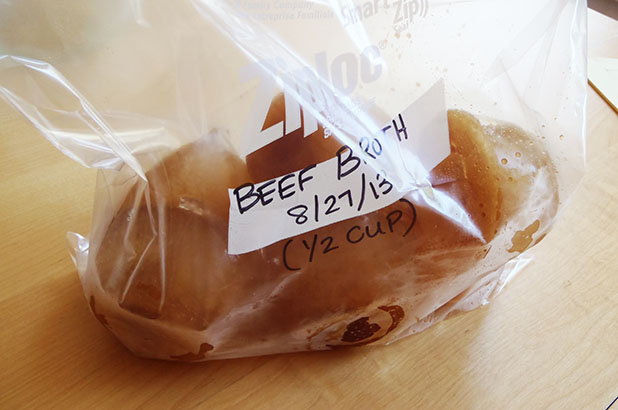
OLYMPUS DIGITAL CAMERAOLYMPUS DIGITAL CAMERAI label the bags with the date I froze the broth and the portion measure. Next time I need a half cup of broth I can just take out a puck instead of thawing the whole batch!!! This works great for other smaller things too. I freeze tomato paste in little 1 Tbsp scoops, and my mom uses her ice cube try to freeze pestos and other herb purees! 

OLYMPUS DIGITAL CAMERA


DIY: Hand-Stamped Wedding Thank You Cards

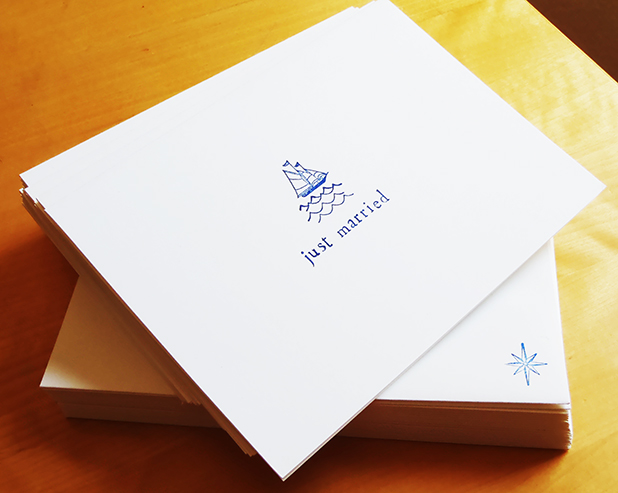
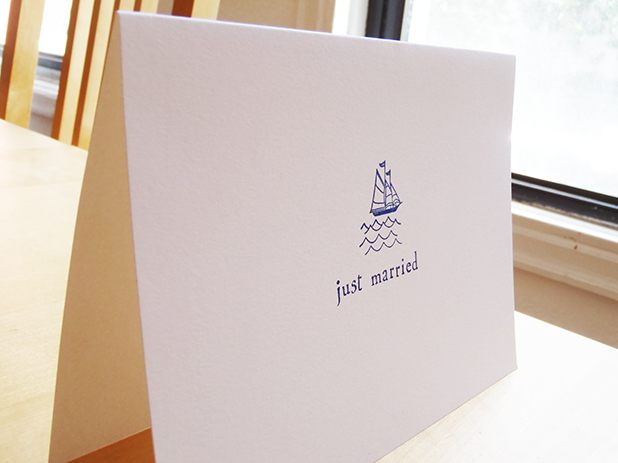
My in-laws’ beautiful sailboat was very involved in our wedding, so when it came to making some ‘Thank You’ cards I wanted to keep with the nautical theme. I decided to try my hand at rubber stamping and wound up with some pretty cute note cards, if I do say so myself!

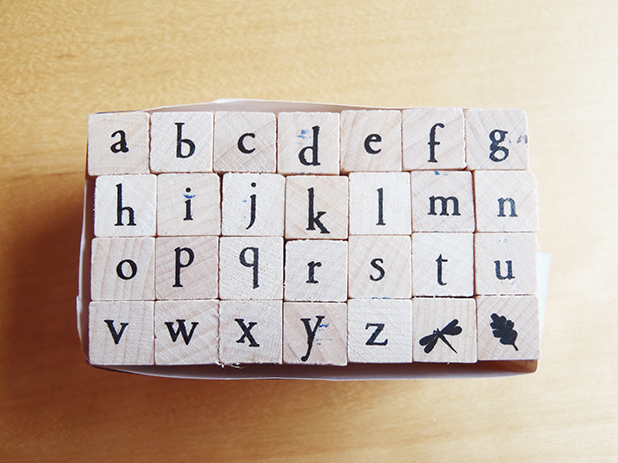
OLYMPUS DIGITAL CAMERAAfter poking around the stationary section at my local art store for a while, I decided to buy individual alphabet stamps rather than stamps with phrases already on them. While individually stamping each letter is definitely more tedious, have the whole alphabet gives me much more flexibility and lets me use the stamps for different projects (like my new blog header! You like??). I liked the Times New Roman typewriter-looking fonts and figured these would be more forgiving if I didn’t stamp in a perfectly straight line.

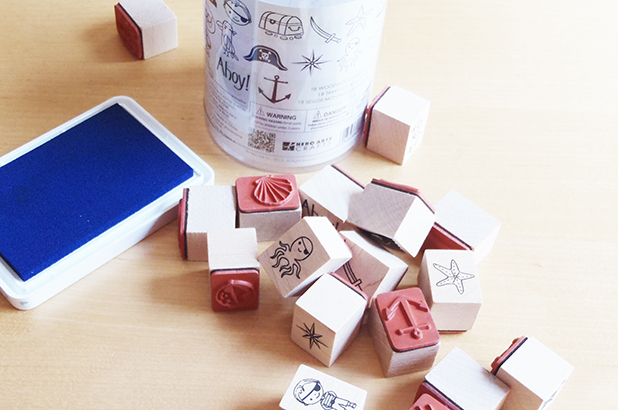
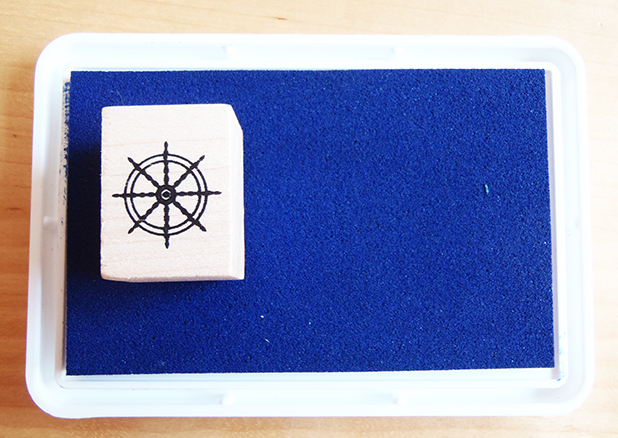
OLYMPUS DIGITAL CAMERAOLYMPUS DIGITAL CAMERAI also went with a set of cute nautical-themed stamps. I picked a set that had a least 4 or 5 stamps that I thought I could use for the cards and envelopes but also some stamps that might be cute for future projects (like the skull and bones!!!)

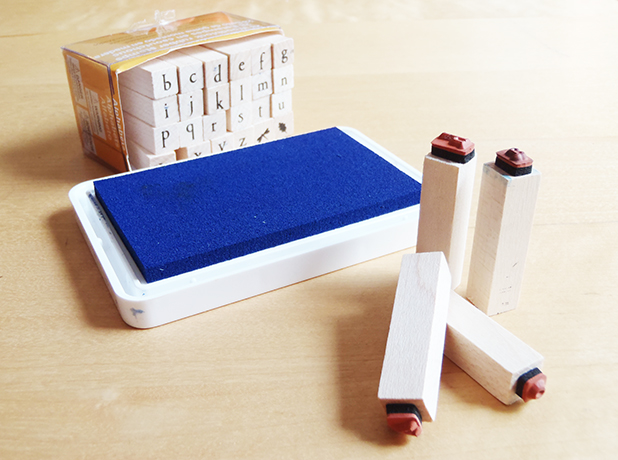
OLYMPUS DIGITAL CAMERATo be honest, I didn’t really put much careful thought into my choice of ink and just knew that I wanted a nice seaworthy shade of blue. Once I got home and actually read the package, I found that I had apparently bought a water-based ink that could also be heat-set and used to stamp fabrics!!!! Look out adorable textiles, here I come!!! The ink was supposed to be quick-drying, and for the most part it was. I found though, that even about 10 minutes after stamping (onto cards that were specifically made for stamps) I could still smudge the images with my thumb using a bit of pressure. After leaving everything out overnight it dried completely and there were no more smudging issues.

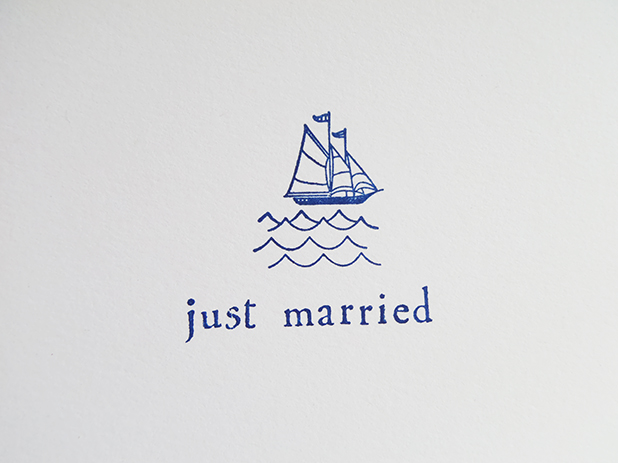
OLYMPUS DIGITAL CAMERAMy inspiration for the front of the cards was a cute stamp I saw online that had a view of the back of a car with a “Just Married” sign and tin cans trailing behind. I thought it would be super cute if I could do the same with a boat! I tried drawing some tin cans behind the boat stamp and that just looked….well….stupid. So I left it alone. I like the way it turned out, like we’re sailing into the sunset for an explorer’s honeymoon…

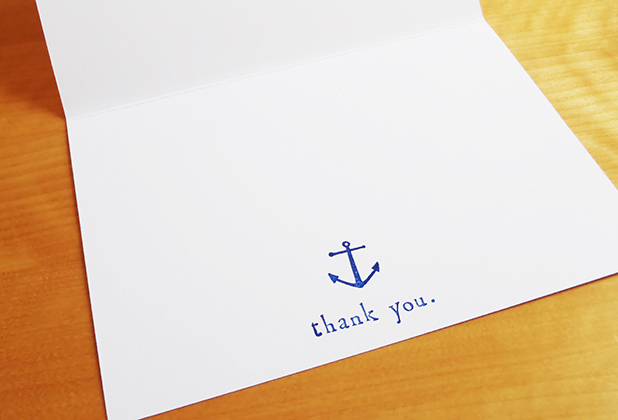
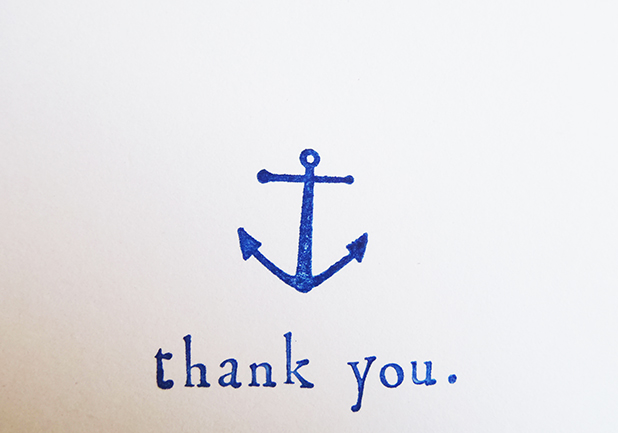
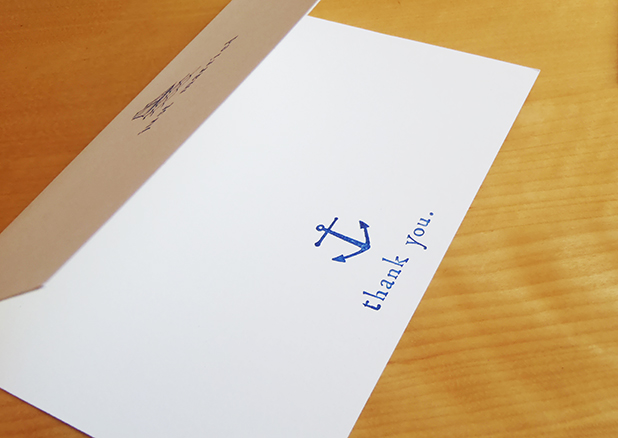
OLYMPUS DIGITAL CAMERAOLYMPUS DIGITAL CAMERAI played around a bit with the positioning of the ‘Thank You’ on the inside of the card and decided that I liked it best centered at the bottom of the card. It still felt prominent but left room to write personal notes to everyone who helped make our day incredible!

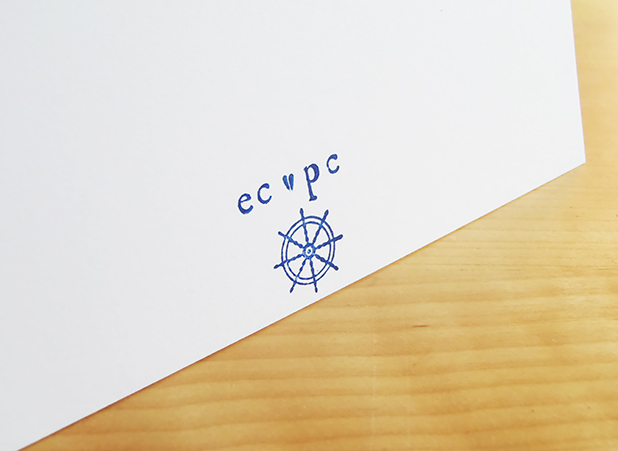
OLYMPUS DIGITAL CAMERAOLYMPUS DIGITAL CAMERAOLYMPUS DIGITAL CAMERAAs a final touch for the cards I also put a little stamp on the back with “ec ❤ pc”. Which brings me to another point. Think creatively about the stamps you have. My kit didn’t come with any punctuation or a heart stamp. For the period in “thank you.” I simply used just the dot from the letter “j” and for the heart on the back I used just the wing of a firefly stamp that mysteriously came with the alphabet stamp.

OLYMPUS DIGITAL CAMERAI really enjoyed playing with stamps and can’t wait to try stamping fabric. I’ll tell ya though, not sure if I would have enjoyed the process as much if I had more than about 25 cards to make!!